
ERL 200 - Study of a wind turbine - simulation with a wind tunnel
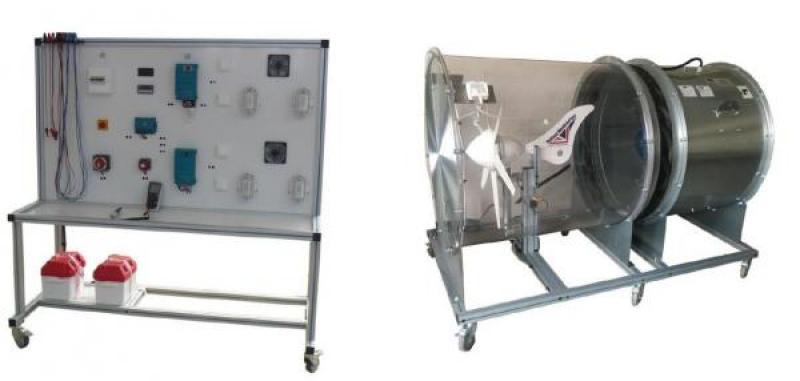
The ERL200 bench allows the complete study of a production chain of electrical energy by wind turbine
The unit includes a ventilation tunnel with axial fan in which is installed a wind turbine. The fan is positioned downstream of the wind turbine in order to reduce aeraulic disturbances. The control and production system is an independent module. It includes the general electrical panel, batteries, the production chain components (controller, inverter) and the dissipation elements (lamps, fan).
Students will initially be familiar with the different elements of the installation and then electrically connect all the components. After validation by the teacher, they can activate the system and measure the operating parameters with the instrumentation in place. They will then have to vary the conditions (wind speed) and calculate the power generated and the different efficiencies.
The bench is autonomous and requires a power supply 400VAC three phase + neutral. The modules are mounted on screwed chassis of anodized aluminum profile (dimensions 45x45mm) equipped with directional castors with brake (diameter 100mm).
The robust design of this equipment makes it perfectly suited for use in schools
Need more information?
Contact us- Identification of the components of a power generating installation by wind turbine
- Electrical connection of the different elements of chain production (wind turbine, controller, battery, inverter, production …)
- Commissioning and use of a wind turbine installation
- Understanding of the operation of an wind turbine
- Study of the relation between wind speed and electric power produced
- Implementation of the system and use of the speed variation of wind simulation fan.
- System operation analysis (calculations of electrical power, component efficiencies)
The bench includes at least the following:
A wind tunnel including a fan (A) with variable speed with control by a potentiometer and a wind turbine (B) (24VDC-200W).
The tunnel is made of transparent material (length 1m) in order to visualize the operation of the wind turbine. The frame is equipped with 6 directional casters with brakes.
A production and storage module of energy (C) including :
- the supply electrical box of the machine including standard safety devices
- a touch screen with the following measurements :
- speed of the air (m/s)
- rotational speed of the wind turbine (RPM)
- electrical power at the outlet of the inverter (230VAC) in W
- a quick connector Harting type for electrical connection between the tunnel and this module
- two batteries in parallel to store energy (12VDC / 55Ah x2) with protective box
- a regulator/charge controller
- an inverter (24VDC / 230VAC-500W)
- a charger for the battery
- a load area 24VDC including two lamps and a fan
- a load area 230VAC including two lamps and a fan
So that the system is electrically connected by the students in complete safety, each electrical terminal of each component is reduced on the front panel on a dual socket sink.
The dual sink cords needed to connect are provided.
The bench is supplied with the following instrumentation:
- a portable multimeter with AC/DC clamp ammeter to measure the voltages and currents at the terminals of various elements
- Power supply : 400 Vac – 50 Hz – 32 A
- Power supply type: 3 phase(s) + Neutral + Earth.
- Dimensions: (LxWxH mm):
Wind tunnel : 2000 x 1200 x 1800
Production module : 1760 x 770 x 1820
Other equipment that may suit you
See the full catalogue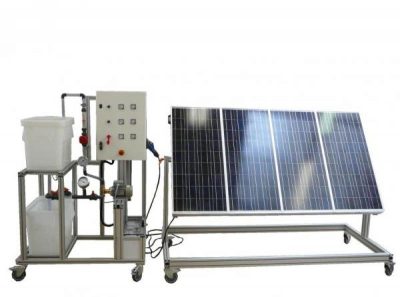
Renewable energies
ERS 600
Solar pumping station
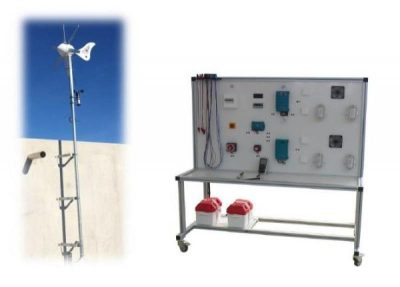
Renewable energies
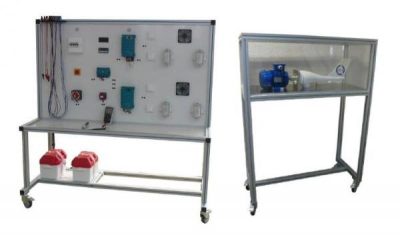
Renewable energies
Renewable energies
ERS 500