
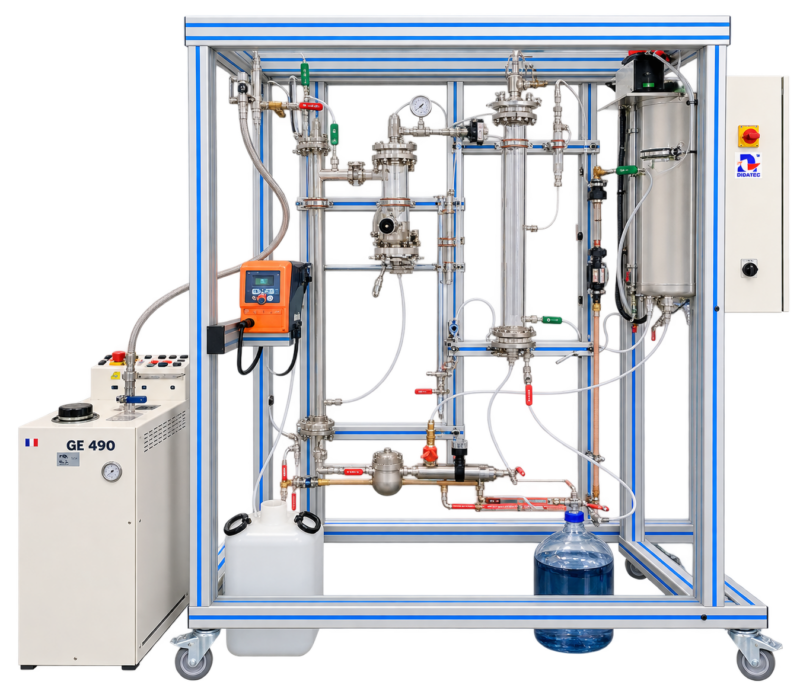
GPC V20 - Single-effect evaporator
The GPC V20 bench allows the study of single-effect evaporation.
A mixture will be fed using a dosing pump into the evaporator. In this evaporator, the mixture will be heated thanks to a double envelope to allow one of the phases to evaporate. The liquid mixture then passes through a cyclone for phase separation. The liquid phase is recovered in a recipe at the outlet of the cyclone, the vapor phase passes through a condenser and is then recovered in a recipe.
The rugged design of this equipment makes it perfectly suited for use in a school setting.
Its anodized aluminum structure on wheels gives it a very high robustness as well as great flexibility of integration into your premises. The manufacture of this equipment complies with the European Machine Directive.
Need more information?
Contact us- Identification of the components of an evaporation plant
- Commissioning and adjustment
- Concentration of a solution by evaporation
- Influence of operating conditions:
- Operating pressure
- Product feed rate
- Steam flow
- Heat and mass balances,
- Return
- Feed tank
-60L round polyethylene feed tank with removable lid - Dosing pump
-Variable displacement dosing pump up to 16L/h (diaphragm dosing pump, piston stroke and pulsation frequency adjustment
-with temperature probe, sample taking and relief valve - Evaporator
Evaporator with DN50 borosilicate industrial glass calender, 1.15m long evaporator with an exchange surface > 0.15m² (stainless steel tube containing the steam). - Glass cyclone
Cyclone collecting the vapor coming out of the evaporator. The steam exits from the top towards the condenser and the liquid falls downwards. An external tube installed parallel to the bottom of the cyclone allows the excess liquid to be drawn to a recipe - Glass bulb
Glass graduated bulb with isolation valve to quantify the amount of liquid withdrawn - Condenser
Condenser with industrial borosilicate glass shell and stainless steel coil (central tube + coil) with isolation valve and vacuum connection.
Pt 100 temperature probes at the following points:
-cooling water inlet
-condenser outlet water
-condensate - Glass collection tank
2 glass tank, graduated, 10L, transparent safety coating. (1 recipe for condensate and 1 recipe for concentrated solution)
Each recipe is equipped with a drain valve in the lower part and a vacuum valve in the upper part. - Steam boiler
12KW power electric steam boiler with machine steam supply line including shut-off valves, adjustable expansion valve, solenoid valve, control valve and thermodynamic trap. The steam hoses are insulated and identified with the risk of hot parts - Vacuum pump
– Vacuum Pump Flow Rate 30L/Min vacuum up to 100MBAR
– The vacuum circuit consists of the following components: isolation valve, glass trap, juice elevator connection, process isolation valve, control valve, needle vacuum gauge, general vent valve, automatic relief valve and process balancing link. - Cooling system
– cooling network comprising for each element requiring cooling: a pressure regulator, an isolation valve, a flow control valve and a float flow meter - Electrical cabinet
– With the elements necessary for the proper functioning and safety of the equipment
– Punch stop, 30 mA differential…
– 7” color touch measurement screen with synoptic and real-time measurements - Instrumentation
-Cooling flow rates
– Pt100 temperature sensors at characteristic points (water I/O, evaporator, condensate, liquid supply, steam supply)
-needle vacuum gauge
-Steam pressure gauge
-volume of feed products (feed tank) and products (recipes)
- Electrical supply : 400 Vac – 50 Hz – 32 A
- Electrical network : 3 phase(s) + Neutral + Earth.
- Water supply : 8 L/min – XX bars
- Water drain : on the floor
- Dimensions: (LxWxH mm): 2000 x 800 x 2000
- weight (Kg): 170
Other equipment that may suit you
See the full catalogue
Evaporation
GPC V30