
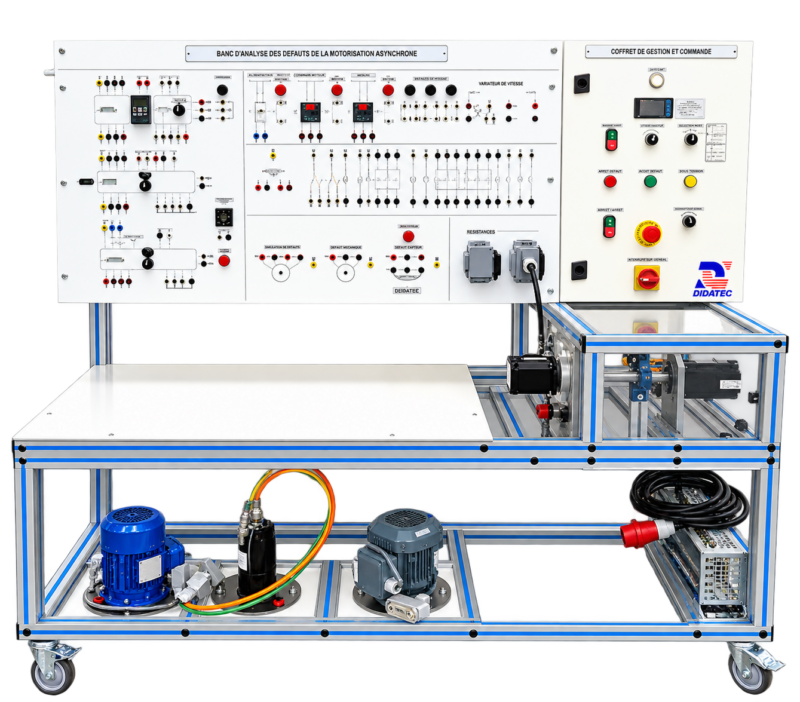
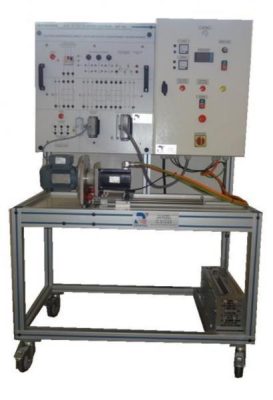
MOT 100 - Test bench for electric motors
The principle of the bench is to study and characterize the behavior of 4 different types of electric motors (asynchronous, synchronous, brushless and direct current), to study their control modes and associated protections
The wiring of the control and power part is carried out using 4mm double well safety cables, with a keying to prevent crossings between 24V control circuits and 230 or 400V voltages.
It is equipped with a charging motor that allows a resisting torque or a driving torque to be applied to the motor to be studied by means of a mid-point potentiometer.
The bench is fully instrumented for the measurement of engine torque, speed, active power of the wiring and is supplied with a quality clamp meter allowing precise readings to be taken at different points :
- Measurement of DC and AC voltages up to max. 600 V
- Measurement of DC and AC currents up to max. 100 A
- Measurement of resistances up to 20 MΩ
- Continuity check (< 10 Ω, acoustic), Diode test, Capacitance measurement up to 2 mF, Non-contact voltage detector (NCV function) ≥100 – 600 V/AC and at a distance ≤15 mm
The whole thing is completely safe and prevents any operation if all the components and protective elements are not in place.
The rugged design of this equipment makes it perfectly suited for use in a school setting.
Its anodized aluminum structure on wheels gives it a very high robustness as well as great flexibility of integration into your premises.
The manufacture of this equipment complies with the European Machinery Directive
Need more information?
Contact us- Study of a simple synchronous/asynchronous motor control
- Study of a two-way control for synchronous/asynchronous motor
- Study of star/delta switching
- Study of different types of speed variation (frequency inverters, Brushless, programmable stepper driver, etc.…)
- Characterization of the behavior of an asynchronous motor
- Characterization of the behavior of a synchronous motor
- Characterization of the behavior of a brushless motor
- Characterization of the behavior of a DC stepper motor
- 0.55KW THREE-PHASE INVERTER FOR (A)SYNCHRONOUS MOTORS WITH SPEED ADJUSTMENT POTENTIOMETER (Cable connection to a PC included)
2. MONO 6A CIRCUIT BREAKER
3. LEXIUM TRI 400V 18A RMS VARIATOR & + 0-10V GENERATOR FOR SPEED SETPOINT (Cable to connect to a PC included)
4. KINCO / MODBUS PROGRAMMABLE STEPPER DRIVER (Cable to connect to a PC included)
5. AREA WHERE MOTORS ARE CONNECTED TO OTHER ELECTRICAL ELEMENTS
6. WORKTOP
7. ENGINE MOUNTING AREA TO BE STUDIED WITH THE
8. 8.5NM STEPPER MOTOR, 500RPM
9. SYNCHRONOUS MOTOR 0.37KW, 1500RPM
10. 3.4NM BRUSHLESS MOTOR LIMITED TO 2000RPM
11. ASYNCHRONOUS MOTOR 400V/690V, 0.25KW, 1500RPM
12. CONTROL PANEL AND CONTROL BOX WITH RESISTANT OR DRIVING TORQUE ADJUSTMENT POTENTIOMETER
13. CONTROL BUTTON + STAR/TRIANGLE TIME RELAY + 24 VDC POWER SUPPLY
14. 2 MOTOR CIRCUIT BREAKERS : 0.6-1A & 1-1.6A
15. 24 VDC POWER SUPPLY
16. CONNECTION AREA TO RELAYS & CONTACTORS AVAILABLE
17. CONNECTION AREA OF THE MOTOR CONNECTORS TO THE WIRING BOARD
18. 5.9NM BRUSHLESS TYPE CHARGING MOTOR, LIMITED FROM 500 TO 2000 RPM, DEPENDING ON THE MOTOR TO BE STUDIED
19. BRAKE RESISTANCE 1.1KW 28OHMS
- Power supply: 400 Vac – 50 Hz – 16 A
- Power Supply Type: 3 Phase + Neutral + Ground.
- Dimensions : (LxlxH mm): 1840 x 770 x 1730
- Weight (kg) : 210
Other equipment that may suit you
See the full catalogue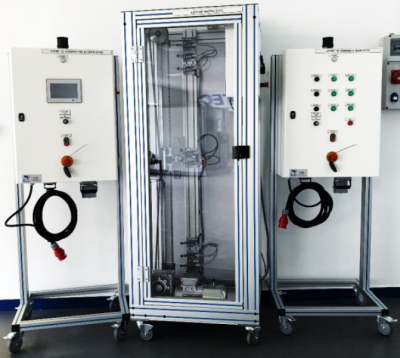
Electrical engineering
ELV 100
Lift training system
Electrical engineering
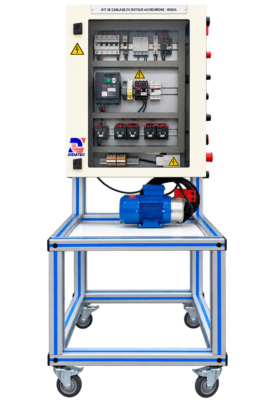
MOB I20
Asynchronous motor wiring kit
Electrical engineering
Electrical engineering
MOT 050