
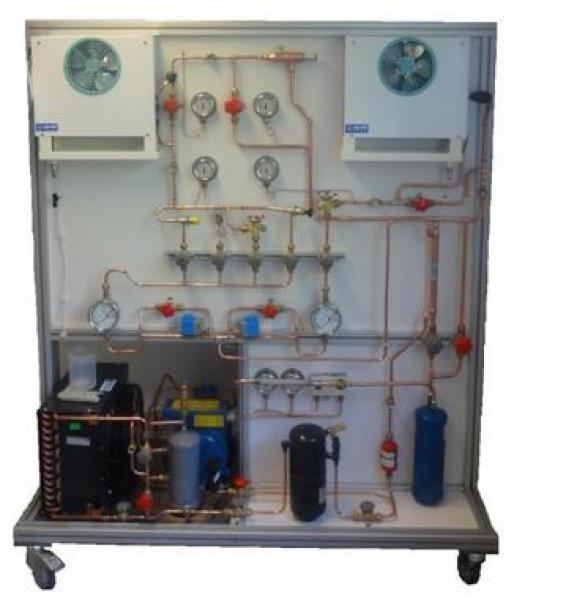
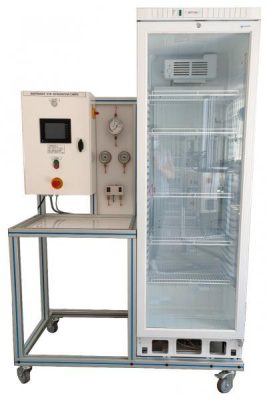
CRC 115 - Refrigeration troubleshooting trainer 15 faults
The trainer CRC115 has been designed to study the faults simulation on a refrigeration circuit. It is based on a commercial refrigeration installation with two evaporators and a semi hermetic condensing unit. Students will start by identifying the components of the circuit and understand how the system works. They can then switch it on and check operation using the fixed instrumentation (manometers and flow meters) and portable instrumentation (thermometer).
When the installation is in normal operation, the teacher can then cause electrical faults (by screen control) or fluidic faults (manual valves). Students will then do the troubleshooting using their knowledge and instrumentation at their disposal.
To go further in the study of the installation, students can also study the refrigeration cycle of the system and calculate the cooling power.
The robust design of this equipment makes it perfectly suited for use in schools.
Its anodized aluminum structure on feet gives it great robustness as well as great flexibility of integration into your premises. The manufacturing of this equipment meets the European machine directive.
Need more information?
Contact us- Identifying the components of a refrigeration system with two evaporators
– Commissioning and functional verification
– Study of the basic concept of a refrigeration installation, with double evaporation.
– Study of the thermodynamic cycle on enthalpy diagram.
– Calculation of cooling capacities at the condenser and evaporators.
– Role and Setting of Constant-Pressure Valves
– Oil circuit study Simulation of faults on the refrigeration and electrical circuit by control with touch screen:
– Fault due to lack of load
– Over-load fault
– Poor condenser exchanges
– Poor exchanges at evaporators
– Clogged Dehydrator
– Solenoid valve leak
– Expansion valve malfunction
– Constant Pressure Valve Malfunction
– Overcurrent on the compressor motor
– Cutting a phase at the compressor motor
– Condenser fan shutdown
– Evaporator fan shutdown
– Solenoid Valve Coil Fault
– Safety pressure switch defect
– Faulty anti-short cycle delay
– Study of the different modes of expansion and their faults
- Semi-hermetic compressor, cooling capacity : around 2100 W equipped with anti-vibration pipes and two service valves
2. Low-pressure pressure gauge with dual temperature/pressure scale at compressor suction
3. HLP double pressure switch (LP Regulation-HP Safety)
4. High-pressure pressure gauge at compressor discharge with dual temperature/pressure scale
5. Safety valve
6. Oil separator with sight glass on the compressor return line
7. Air-cooled condenser
8. Pressure inverter for high-pressure regulation
9. Condenser inlet and outlet liquid sight glass
10. Steel Liquid Tank with 1.5L Volume Service Valve
11. Filter drier and fluid status indicator on the liquid line
12. Mono tubular liquid/vapor exchanger
13. Evaporator line N°1 composed of:
-A solenoid control valve
-A refrigerant flow meter
-A thermostatic expansion valve with internal pressure equalization
-A low-pressure pressure gauge with double temperature/pressure scale at the evaporator inlet
– a fluid sight glass at the inlet of the evaporator
– a forced ventilation evaporator (around 400W)
– a fluid sight glass at the outlet of the evaporator14. Evaporator line N°2 composed of:
-A solenoid control valve
-A refrigerant flow meter
-A thermostatic expansion valve with internal pressure equalization
– a capillary expansion valve
-a constant pressure expansion valve
– a faulty constant pressure expansion valve
-A low-pressure gauge with double temperature/pressure scale at the evaporator inlet
– a fluid status sight glass at the inlet of the evaporator
– a forced ventilation evaporator (about 400W)
– a fluid status sight glass at the outlet of the evaporator
-a constant-pressure valve
15. A suction line accumulator (volume: 2.3L)
16. A low-pressure gauge with double temperature/pressure scale at the outlet of the evaporators
17. A set of manual valves to create the fluidic failures detailed in educational applications
18. An electrical power box including:
– the mandatory protection elements (punch-type stop, general disconnect, differential circuit breaker)
– the circuit breakers and relays necessary for operation
– a touch screen for simulating faults
19. The bench is supplied with a portable thermometer, two wired thermocouple probes and a contact probe.
20. The bench is supplied with a removable tray for condensate collection.
- Power supply : 230 Vac – 50 Hz – 10 A
- Power supply type: 1 phase(s) + Neutral + Earth.
- Dimensions: (LxWxH mm): 1500 x 650 x 1750
- weight (Kg): 210
Other equipment that may suit you
See the full catalogue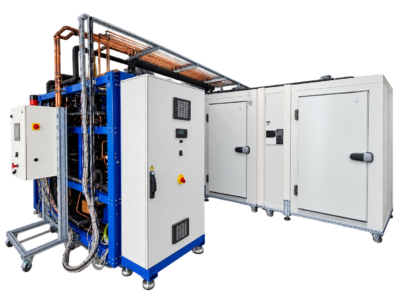
Refrigeration
BOO CO2
CO2 booster system
Refrigeration
Refrigeration
OUT 410
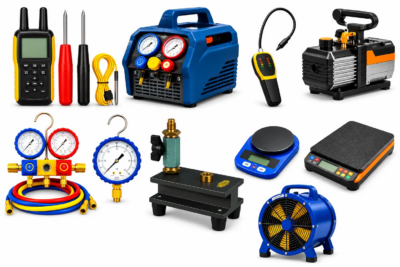
Tools kit for air conditioning
Refrigeration
CRM 016