
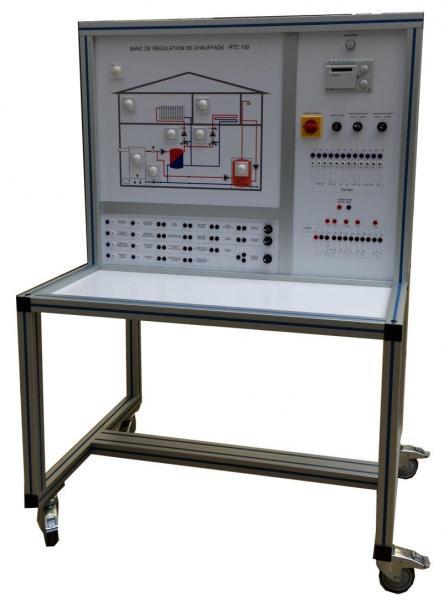
RTC 100 - Heating control system
The RTC 100 bench allows the study of the control heating systems in buildings. It consists of a steel panel with a standard controller allowing to regulate two heating loops (1x heated floor circuit and 1x radiator circuit) and a loop of production of DHW (DHW). The bench can be used in simulation (connecting the controller towards the synoptic) or in a real situation (connecting the controller towards a real production bench).
Users will realize the wiring of inputs and outputs of the controller. They can use the dual sink sockets and cords supplied or a switch that connects directly to the synoptic to internal controller.
They will then turn on the system and configure the controller (heating curve, valve action time, clock …). They can then verify the proper operation of the whole by adjusting the synoptic simulation potentiometer.
The robust design of this equipment makes it perfectly suited for use in schools.
Its anodized aluminum profile structure on multidirectional wheels with brakes makes it extremely robust as well as great flexibility of integration into your premises. The manufacturing of this equipment meets the European machine directive
This equipment can be used alone or with other compatible equipments in our range (see last section of this document).
Need more information?
Contact us- Identification of components of a heating control loop
- Wiring the inputs and outputs of a heating controller (the connection towards the synoptic can be done manually by double-cords sink or very quickly via a switch that directly connects the two parts)
- Simulation operation: Connection of controller inputs and outputs to the synoptic table
- Real situation operation: connection of inputs outputs of controller towards a compatible complementary bench (optional)
- Commissioning and adjustment of operating conditions
- Configuring the controller and verifying the proper operation (heating curve …)
Synoptic of simulation:
- Synoptic representing a house with two heating regulating circuits (by radiator (x1) and by heated floor (x1)) and a production circuit of DHW.
- Potentiometers of temperatures simulation (x8) with connection sockets (white and purple):Outer probe, temperature probe ambient room 1, probe ambient room 2, flow probe radiator, flow probe flooring circuit, flow probe boiler, boiler and DHW tank probe
- Green LEDs for operation status (x11) with connection sockets (brown and black):Burner stage 1, burner stage 2, pump primary circuit, radiator circuit pump, flooring circuit pump, radiator valve circuit (2 lights-opening and closing), valve flooring circuit (2 lights-opening and closing), DHW circulation pump, pump of DHW circulation.
- Default red lights (x3) with connection sockets (brown and black):Default of primary circuit flow rate, overheating boiler and overheating circuit heated floor.
- On/Off switches for fault simulation (x3) with connection sockets (black):Default primary circuit flow rate, overheating boiler and overheating circuit heated floor.
- Heating controller of RVP type 361 and of brand SIEMENS with digital electronic display.
- Engraved plate with connection sockets of the inputs. Each socket is marked with the controller input number (ex: B31)
- Engraved plate with connection sockets of the outputs. Each socket is marked with the controller input number (ex: K5)
- Switches allowing to select the external wiring (manual by cords) or internal (pre established connection)
Controller:
- Switch to turn on with key and white LED voltage presence
General specifications :
- Console includes a 30 mA circuit breaker, magneto thermal circuit breakers, a 230VAC / 24VAC transformer and of relays.
- Aluminum profile support chassis equipped with four directional casters with brake and allowing use of the console by a standing man..
The bench comes with a batch of safety cords allowing to the complete connection of the bench
- Power supply: 230 Vac – 50 Hz – 10 A
- Power supply type:1 phase(s) + Neutral + Earth
- Dimensions: (LxWxH mm): 1105 x 755 x 1630
- weight (Kg): 60
Other equipment that may suit you
See the full catalogue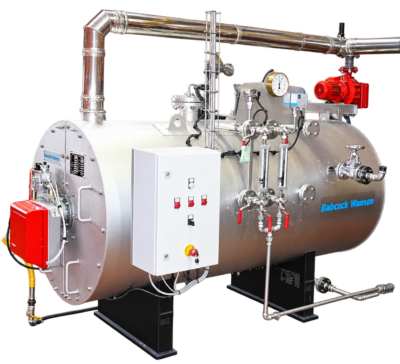
Heating
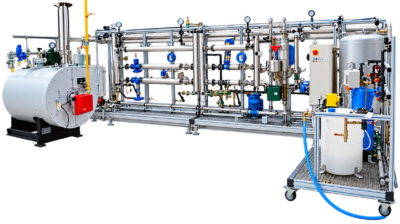
Heating
TVP 500
Steam production and supply
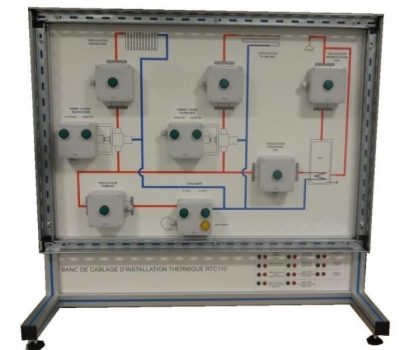
Heating
RTC 110
Wiring breadboard
Heating
ANA 100