
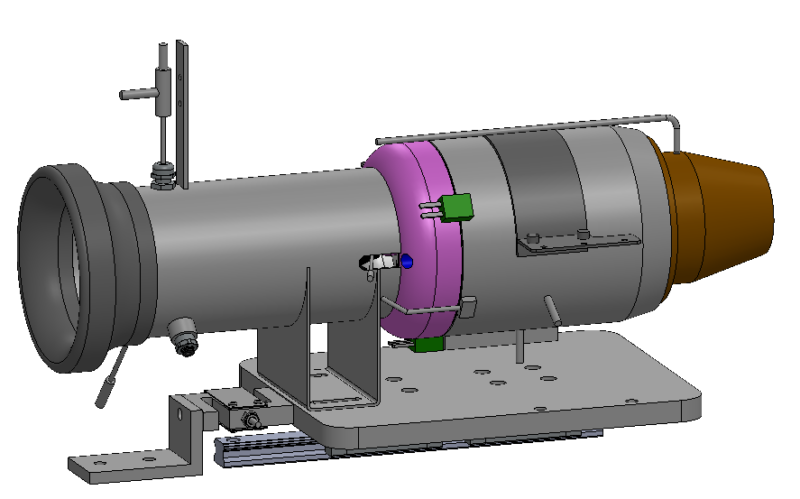
TGT 020 - Jet engine trainer
The TGT 020 trainer investigates the operation of a jet engine.
TGT 020 includes the following components: jet engine (with compressor, combustion chamber, turbine and propelling nozzle), fuel system, starter and ignition system and measuring and control equipment. The gas turbine works as an open cyclic process, with the ambient air being drawn out and fed back in the jet engine the ambient air drawn in is first brought to a higher pressure in the single-stage radial compressor. In the downstream combustion chamber, fuel is added to the compressed air and the resulting mixture is combusted. The temperature and flow velocity of the gas increase. The gas flows out of the combustion chamber into the single-stage axial turbine and discharges a portion of its energy to the turbine. This turbine drives the compressor. In the propelling nozzle, the partially expanded and cooled gas expands to ambient atmospheric pressure and the gas accelerates to almost the speed of sound. The high-speed gas outflow generates the thrust. In order to reduce the outlet temperature, the exhaust gas stream is mixed with the ambient air in a mixing pipe.
Between the compressor and the turbine is the annular combustion chamber. With optimum fuel utilization, low pressure loss and good ignition properties, the ring shape of this combustion chamber is typical for the design used in jet engines. The movable turbine platform, with a strain gauge, enables measurement of the thrust.
The speed, temperatures and mass flow rates of the air and fuel are recorded using sensors.
The measured values are transmitted directly to a computer. The data acquisition software is included.
The robust design of this device makes it suitable for use in schools.
The equipment is set up on an aluminium profile. The frame is also equipped with adjustable feet with rubber to avoid vibrations while the engine is running. This gives it great strength and a flexibility of integration into your laboratory.
The manufacture of this equipment complies with the European standard for machinery manufacturing.
Need more information?
Contact us- Identification of the components
- Standard Operation Procedure of a Jet Engine
- Analysis of the operation of a jet engine
- Determination of the specific thrust
- Determination of the specific fuel consumption
- Determination of turbine efficiency
- Temperature measurement at differents points
- Pressure measurement at differents points
- Security system for the operation of the turbine
- Recording of characteristics curves
- Diagramm T-S (temperature in function of entropy)
- Fuel tank
The turbine can use the following fuel :
- kerosene JET-A1 + turbine oil
- petroleum de-aromatized + turbine oil
Volume : 20L
Drain valve at the bottom and vent and filling hole on the top.
The tank is made of stainless steel and is equipped with a lateral level gauge
- Electricalal box
The machine includes an electrical box conforming to European standards. It contains at least:
- a general power disconnector
- a 30mA differential circuit breaker
- relaying and circuit breakers necessary for operation
- the button and indicators necessary for operation
- an emergency stop button
- a 7" touch screen to display the measure locally
- a potentiometer to adjust the power of the jet engine
- the pocket controller for the jet engine
- Frame
Transparent protective screen for better visibility and safety
The unit is set up on an anodized aluminum frame on castors wheels
- Jet engine
Brand : Jet Cat
Type : P200RX
Max thrust : 230 N at 112 000 min-1
Speed range : 33 000 to 112 000 min-1
Fuel consumption : max 850 ml/min
Exhaust gas temperature : 200 °C at 1 m distance
Sound level at 1 m distance : 130 dB
Electrical start of turbine
- Measurements
The system is fully instrumented to collect the data and study the jet engine. All the data are displayed on a local touch screen and are send to the data acquisition system as well.
The system includes the following sensors :
Pressure sensors (digital sensors):
atmospheric pressure (Patm), air inlet (P1), outlet of the compressor (P2), inlet of the turbine (P3), outlet of the turbine (P4)
Temperature sensors (thermocouple K type):
atmospheric temperature (Tatm), fresh air inlet (T1), outlet of the compressor (T2), fuselage (T3), inlet of the turbine (T4), outlet of the turbine (T5), nozzle outlet (T6)
Air velocity (pitot tube) : (m/s)
Rotational Speed of the turbine (optical system): (rpm)
Thrust (load cell) : (kg)
Fuel consumption (turbine flowmeter): (cm3/min)
- Electrical supply: 230 VAC – 50 Hz – 20 A
- Fuel : kerosene Jet-A1, or petroleum dearomatised + turbine oil mix at 5% (1 L oil included)
- Exhaust gases extractor in stainless steel
- Dimensions: (L x W x H mm): 1100 x 785 x 1780
- weight (Kg): 130
Other equipment that may suit you
See the full catalogue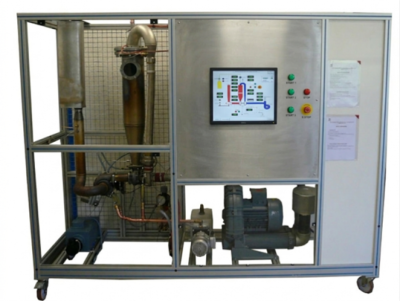
Turbines
TGT 1.5
Two-shaft gas turbine
Turbines
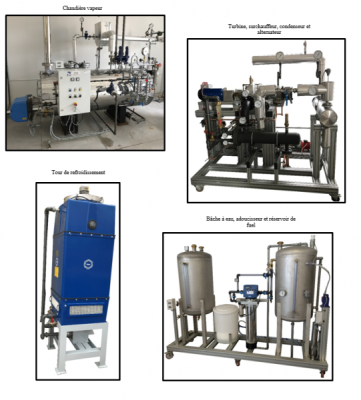
TVT 1 kW
Steam turbine unit 1 kw
Turbines
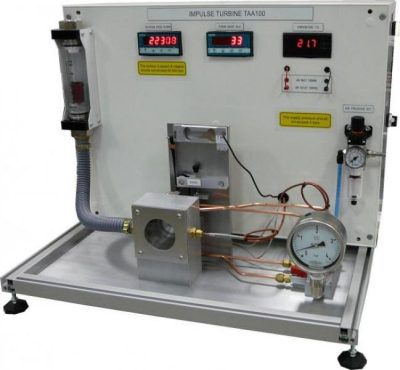
TAA 100